
Rebecca E. Koch
Assistant Professor
University of Wisconsin-Stevens Point
TELLING WHO'S WHO: Colored leg bands
Even to ornithologists, individual birds of the same species and sex are generally indistinguishable from each other! A bird's perspective will capture all kinds of tiny individual differences in feathers, colors, sounds, and even scents, but to our eyes, a female house finch is... a female house finch.
So, in order to be able to see a bird in a tree and who know it is, we have to give each bird individual markers. For small songbirds like house finches, the simplest and safest way to do this is to put colorful little "bracelets" on each bird's legs! These are known as "color bands," and each bird has his or her own unique combination of colors. Here, you can see a female house finch held securely in what is called a "bander's grip," which gently cups the bird against the palm of the hand. This house finch is sporting four new bands: green, aluminum, pink and yellow, from her left leg to right! We can call her "GAPY" for short.

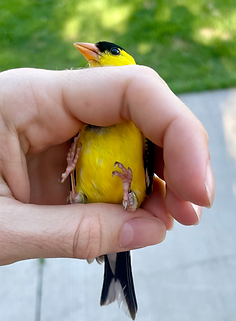
Every bird also gets an aluminum band with a unique numbered identifier printed on it, courtesy of the U.S. Geological Survey (USGS) Bird Banding Lab. While this number is too small to be read from a distance--that's where the color combinations come in handy--the number provides a long-term individual identifier that enters an online database accessible by anyone handling birds within North America. That means if any of our little house finches flies its way up to a bird banding station in Canada, experts will know that this bird came from Stevens Point! When other songbirds accidentally find their way into the nets and cages designed for house finches, I also give them a unique aluminum USGS band to contribute to this (inter)national database. You can see a picture of a beautiful male American goldfinch with his shiny new USGS aluminum band here.